Why Work Area Recovery (WAR) and Disaster Recovery (DR) Sites are not a thing of the past.
Why Work Area Recovery (WAR) and Disaster Recovery (DR) Sites are not a thing of the past.
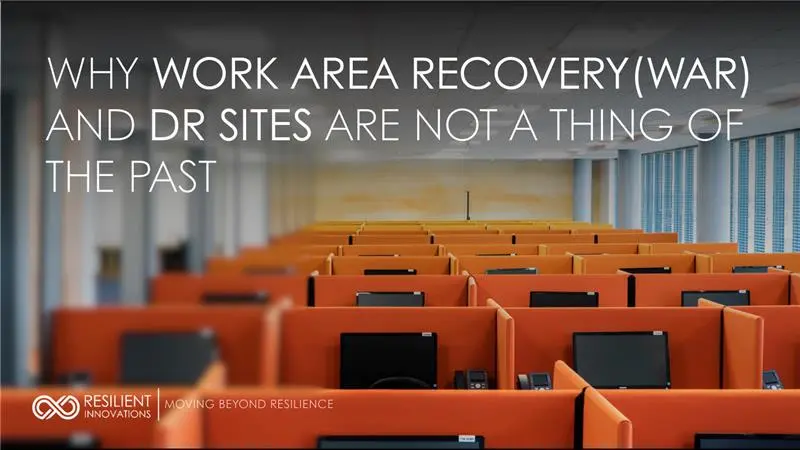
" The concept of the recovery seat has evolved through three distinct eras... "
" The concept of the recovery seat has evolved through three distinct eras... "
The trajectory of Work Area Recovery has undergone a radical transformation over the last couple of years. Now considered a dormant insurance policy, the concept of the recovery seat has evolved through three distinct eras, culminating in the sophisticated environment of today. We have doubled down on this to ensure that our clientele isn’t only prepared for a disruption but is fundamentally built to withstand it.
Years prior to the 2020 pandemic, the use of WAR was largely a static exercise. Organisations viewed property and recovery sites as a compliance tick box, a necessary but rarely used expense. During this period, the usage of physical seats was not as high, reserved for annual audits, testing or rare localised disasters like fires, building floods, strikes etc. It was a world of dedicated and syndicated desks waiting for a catastrophe that many assumed would never come. Your DR site was a physical destination you hoped you’d never have to visit.
The attack of COVID-19 on Work Area Recovery
The onset of the pandemic turned the industry on its head and accelerated the use of WAR by a decade in a matter of months. This was the busiest period in our history. As corporate headquarters were shuttered and social distancing required decentralised operations, the demand for Work Area Recovery actually surged to unprecedented levels. We saw a massive spike in seat utilisation, particularly at the syndicated level, where multiple organisations cautiously shared a pool of recovery resources in order to maintain operations during national lockdowns and during this crisis, the syndicated model was utilised beyond our expectations. This is when businesses realised that simply having a seat wasn't enough. By that time more organisations had implemented cloud solutions which perfectly complements Work Area Recovery in the sense that you have your physical office space covered as well as your technological environment.
What has happened since COVID-19?
As the world emerged from the pandemic, the development of WAR hit a new phase. The rise of hybrid work meant that resilience could no longer be purely physical. This led to the increase of cloud adoption, where digital agility became the primary service used to make clients' lives easier. We recognised that for WAR to be effective in 2026, it had to be fused with tech. By integrating BaaS and DRaaS directly into our work area recovery frameworks, we removed the friction of the failover in this new era. With our cloud and work area recovery capabilities, we ensure that even if a client loses their work office, they remain fully operational because their data is live in our cloud and their key staff are seated in our professional property suites. This synergy between the virtual and the physical has redefined the industry standard.
Have a look at our Area Recovery (WAR) and Disaster Recovery (DR) Sites
A seat at the table
Today, the development of WAR has moved from the high-occupancy chaos of the pandemic into a more refined, proactive era. The "seat" is no longer just a desk and chair; it is a node in a sophisticated Business Resilience strategy. Our current and future developments focus on "Smart Resilience" ensuring that whether your team is at home, in the cloud or in our recovery centres, the transition is invisible to your customers. We have taken the lessons from the busiest days of the pandemic to build the most robust, cloud integrated recovery platform in the market.
The trajectory of Work Area Recovery has undergone a radical transformation over the last couple of years. Now considered a dormant insurance policy, the concept of the recovery seat has evolved through three distinct eras, culminating in the sophisticated environment of today. We have doubled down on this to ensure that our clientele isn’t only prepared for a disruption but is fundamentally built to withstand it.
Years prior to the 2020 pandemic, the use of WAR was largely a static exercise. Organisations viewed property and recovery sites as a compliance tick box, a necessary but rarely used expense. During this period, the usage of physical seats was not as high, reserved for annual audits, testing or rare localised disasters like fires, building floods, strikes etc. It was a world of dedicated and syndicated desks waiting for a catastrophe that many assumed would never come. Your DR site was a physical destination you hoped you’d never have to visit.
The attack of COVID-19 on Work Area Recovery
The onset of the pandemic turned the industry on its head and accelerated the use of WAR by a decade in a matter of months. This was the busiest period in our history. As corporate headquarters were shuttered and social distancing required decentralised operations, the demand for Work Area Recovery actually surged to unprecedented levels. We saw a massive spike in seat utilisation, particularly at the syndicated level, where multiple organisations cautiously shared a pool of recovery resources in order to maintain operations during national lockdowns and during this crisis, the syndicated model was utilised beyond our expectations. This is when businesses realised that simply having a seat wasn't enough. By that time more organisations had implemented cloud solutions which perfectly complements Work Area Recovery in the sense that you have your physical office space covered as well as your technological environment.
What has happened since COVID-19?
As the
world emerged from the pandemic, the development of WAR hit a new phase. The
rise of hybrid work meant that resilience could no longer be purely physical.
This led to the increase of cloud adoption, where digital agility became the
primary service used to make clients' lives easier. We recognised that for WAR
to be effective in 2026, it had to be fused with tech. By integrating BaaS and
DRaaS directly into our work area recovery frameworks, we removed the friction
of the failover in this new era. With our cloud and work area recovery
capabilities, we ensure that even if a client loses their work office, they
remain fully operational because their data is live in our cloud and their key
staff are seated in our professional property suites. This synergy between the
virtual and the physical has redefined the industry standard.
Have a look at our Area Recovery (WAR) and Disaster Recovery (DR) Sites
A seat at the table
Today, the development of WAR has moved from the high-occupancy chaos of the pandemic into a more refined, proactive era. The "seat" is no longer just a desk and chair; it is a node in a sophisticated Business Resilience strategy. Our current and future developments focus on "Smart Resilience" ensuring that whether your team is at home, in the cloud or in our recovery centres, the transition is invisible to your customers. We have taken the lessons from the busiest days of the pandemic to build the most robust, cloud integrated recovery platform in the market.