THE RESILIENCE EXCHANGE
THE RESILIENCE EXCHANGE

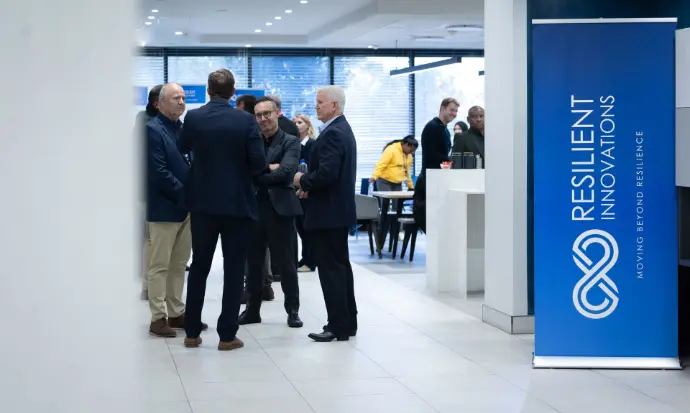
There is a version of a resilience conversation that stays safely theoretical, brought to our attention by one of our keynote speakers. It talks about frameworks. As our reference, Nassim Taleb, uses the word "antifragile" correctly and leaves everyone nodding but also in a state of wonder when it comes to the phenomenon behind change. The Resilience Exchange was built specifically to be the opposite of that.
Now in 2026, the Exchange continues to serve a single purpose which is to create a strategic space where leaders who have been tested by disruption can pass something real to the leaders who are being tested right now. Not insight packaged for a stage. An actual exchange; person to person, scar to scar and lesson to lesson.
Our Exchange opened proceedings with a deliberate refusal to stay comfortable. The directive to the room was clear. To move past the performative metrics of resilience and past the compliance language and into the harder and more honest question, ARE OUR ORGANISATIONS BUILT TO ENDURE? Not just to survive a bad quarter, but to absorb true systemic shock and emerge with more than they started with?
That question shaped everything that followed.
THE HUMAN INFRASTRUCTURE
The company brief we carry into every Exchange makes a claim that sounds almost provocative in an era obsessed with technology, and that is, at its core, psychological and physiological. That the human element is the ultimate engine of corporate survivability and that when black swan events hit, an enterprise does not rise to the level of its software. It sinks to the level of its biological and cognitive conditioning.
The story that silenced the room came from a property sector leader recounting the July 2021 unrest. In 45 minutes, the call had to be made, shut down Waterfall City's worth of operations, with no precedent, no playbook and everything on the line. The morning after, the question was whether they had survived the night. They had. Not because the business continuity plan had held but because the relationships their people had quietly built over years with other people in different business sectors had held instead. Those were the relationships that produced the intelligence and offered intelligence when formal systems could not.
"With all the business continuity systems, with all the disaster recovery, the most important part was our people and the relationships we had. The taxi operators were giving us Intel and protecting us." -JACKIE VAN NIEKERK, CEO of ATTACQ LIMITED
It is easy to file that story under "inspiring" and move on. But the implication is structurally significant. Psychological resilience at the executive level, the capacity for rapid strategic realignment under acute pressure and the ability to override sunk cost thinking in real time depends on leaders who are not physiologically depleted. Chronic crisis mode degrades the prefrontal cortex, the exact brain region responsible for risk assessment and long range planning. If the humans behind the systems are running on empty, the finest technology in the world becomes, in the words of our own brief, an expensive spectator.
HOW CONSTRAINT BECAME COMPETETIVE ADVANTAGE
The second major thread that ran through the Exchange was equally challenging to orthodoxy. It concerned what happens when an organisation simply does not have the resources to do things the conventional way and what it chooses to do instead.
“I had all the resources at other networks and couldn’t finish on time, in budget but this one with no money, on time, on budget. Necessity is the mother of invention” – JORGE MENDES , CEO of CELL C
On one of our panelist's accounts, was a story, a masterclass in what happens when you refuse the obvious path. Faced with a route that would have demanded enormous capital and likely delivered a modest outcome, they chose differently, restructuring their entire operating model, building through partnership rather than ownership and attracting some of the country's most recognised brands as a result. The kind of credibility that followed is not available for purchase. It accrues only to those willing to think differently under pressure.
The innovation model that accompanied this was equally instructive. Rather than selecting a single technology provider for each RFP, of which in any business is the default move, the approach was to run five providers simultaneously, each assigned a specific use case, The logic was unsentimental; sequential experimentation in an environment with no time and no margin for error, simply could not produce the pace of progress required. Artificial intelligence was embedded into this model as a practical tool which was then used to validate decisions, interrogate datasets and further build institutional intelligence that compounds over time.
The billing system story arrived as its own proof point. Three major billing overhauls over a career, the first two bloated with resource and still delivered late. This one which existed in the most constrained environment surprisingly delivered on time, on budget. The lesson is not that money creates poor outcomes. It is that constraint, when met with clarity and courage, eliminates the comfortable decisions that slow businesses down.
RESILIENCE IS NOT A DESTINATION BUT A DISCIPLINE
Michael Avery (Columnist, Business day & Anchor, Fine Music Radio), Jackie van Niekerk (CEO, Attacq Limited), Jorge Mendes (CEO, Cell C) and Warren Hero (Architecture design segment product, South African Revenue Service et. al) each brought a distinct vantage point to the Exchange which is shaped by years of steering capital and people through macroeconomic disruption. What they shared could not have been scripted because it came from the specific texture of lived experience and the kind of resilience they had to carry fourth during these times.
What emerged from their contributions and from the conversation as a whole, was a picture of resilience that looks nothing like its corporate definition but is, as the Exchange itself was designed to embody, a continuous act of exchange between leaders, between disciplines, between the hard lessons of the past and the uncertain demands of the future.
There is also a proof point problem worth naming. Being technically excellent, having the background, the awards, the benchmarks mean nothing if the people it is meant to serve cannot feel it. One panelist put it plainly, “telling a customer they are on the best network is worthless if they cannot make a call where they stand.” Resilience, like trust, only counts when it shows up in lived experience
That is the standard the Exchange holds itself to as well.
There is a version of a resilience conversation that stays safely theoretical, brought to our attention by one of our keynote speakers. It talks about frameworks. As our reference, Nassim Taleb, uses the word "antifragile" correctly and leaves everyone nodding but also in a state of wonder when it comes to the phenomenon behind change. The Resilience Exchange was built specifically to be the opposite of that.
Now in 2026, the Exchange continues to serve a single purpose which is to create a strategic space where leaders who have been tested by disruption can pass something real to the leaders who are being tested right now. Not insight packaged for a stage. An actual exchange; person to person, scar to scar and lesson to lesson.
Our Exchange opened proceedings with a deliberate refusal to stay comfortable. The directive to the room was clear. To move past the performative metrics of resilience and past the compliance language and into the harder and more honest question, ARE OUR ORGANISATIONS BUILT TO ENDURE? Not just to survive a bad quarter, but to absorb true systemic shock and emerge with more than they started with?
That question shaped everything that followed.
THE HUMAN INFRASTRUCTURE
The company brief we carry into every Exchange makes a claim that sounds almost provocative in an era obsessed with technology, and that is, at its core, psychological and physiological. That the human element is the ultimate engine of corporate survivability and that when black swan events hit, an enterprise does not rise to the level of its software. It sinks to the level of its biological and cognitive conditioning.
The story that silenced the room came from a property sector leader recounting the July 2021 unrest. In 45 minutes, the call had to be made, shut down Waterfall City's worth of operations, with no precedent, no playbook and everything on the line. The morning after, the question was whether they had survived the night. They had. Not because the business continuity plan had held but because the relationships their people had quietly built over years with other people in different business sectors had held instead. Those were the relationships that produced the intelligence and offered intelligence when formal systems could not.
"With all the business continuity systems, with all the disaster recovery, the most important part was our people and the relationships we had. The taxi operators were giving us Intel and protecting us." -JACKIE VAN NIEKERK, CEO of ATTACQ LIMITED
It is easy to file that story under "inspiring" and move on. But the implication is structurally significant. Psychological resilience at the executive level, the capacity for rapid strategic realignment under acute pressure and the ability to override sunk cost thinking in real time depends on leaders who are not physiologically depleted. Chronic crisis mode degrades the prefrontal cortex, the exact brain region responsible for risk assessment and long range planning. If the humans behind the systems are running on empty, the finest technology in the world becomes, in the words of our own brief, an expensive spectator.
HOW CONSTRAINT BECAME COMPETETIVE ADVANTAGE
The second major thread that ran through the Exchange was equally challenging to orthodoxy. It concerned what happens when an organisation simply does not have the resources to do things the conventional way and what it chooses to do instead.
“I had all the resources at other networks and couldn’t finish on time, in budget but this one with no money, on time, on budget. Necessity is the mother of invention” – JORGE MENDES , CEO of CELL C
On one of our panelist's accounts, was a story, a masterclass in what happens when you refuse the obvious path. Faced with a route that would have demanded enormous capital and likely delivered a modest outcome, they chose differently, restructuring their entire operating model, building through partnership rather than ownership and attracting some of the country's most recognised brands as a result. The kind of credibility that followed is not available for purchase. It accrues only to those willing to think differently under pressure.
The innovation model that accompanied this was equally instructive. Rather than selecting a single technology provider for each RFP, of which in any business is the default move, the approach was to run five providers simultaneously, each assigned a specific use case, The logic was unsentimental; sequential experimentation in an environment with no time and no margin for error, simply could not produce the pace of progress required. Artificial intelligence was embedded into this model as a practical tool which was then used to validate decisions, interrogate datasets and further build institutional intelligence that compounds over time.
The billing system story arrived as its own proof point. Three major billing overhauls over a career, the first two bloated with resource and still delivered late. This one which existed in the most constrained environment surprisingly delivered on time, on budget. The lesson is not that money creates poor outcomes. It is that constraint, when met with clarity and courage, eliminates the comfortable decisions that slow businesses down.
RESILIENCE IS NOT A DESTINATION BUT A DISCIPLINE
Michael Avery (Columnist, Business day & Anchor, Fine Music Radio), Jackie van Niekerk (CEO, Attacq Limited), Jorge Mendes (CEO, Cell C) and Warren Hero (Architecture design segment product, South African Revenue Service et. al) each brought a distinct vantage point to the Exchange which is shaped by years of steering capital and people through macroeconomic disruption. What they shared could not have been scripted because it came from the specific texture of lived experience and the kind of resilience they had to carry fourth during these times.
What emerged from their contributions and from the conversation as a whole, was a picture of resilience that looks nothing like its corporate definition but is, as the Exchange itself was designed to embody, a continuous act of exchange between leaders, between disciplines, between the hard lessons of the past and the uncertain demands of the future.
There is also a proof point problem worth naming. Being technically excellent, having the background, the awards, the benchmarks mean nothing if the people it is meant to serve cannot feel it. One panelist put it plainly, “telling a customer they are on the best network is worthless if they cannot make a call where they stand.” Resilience, like trust, only counts when it shows up in lived experience
That is the standard the Exchange holds itself to as well.