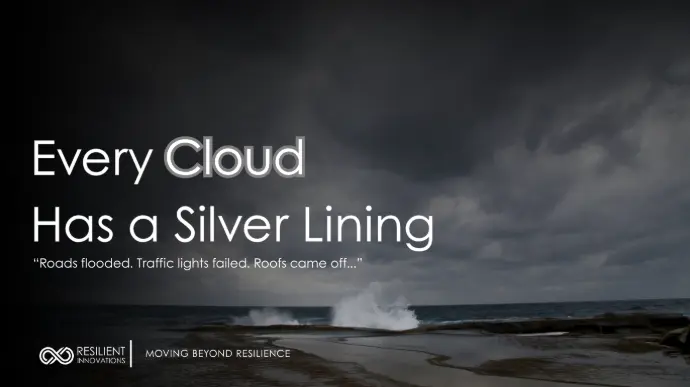
Every Cloud Has A Silver Lining
“Roads flooded. Traffic lights failed. Roofs came off and on top of all those tragic events, a second cold front with winds exceeding 100km/h is already on its way"
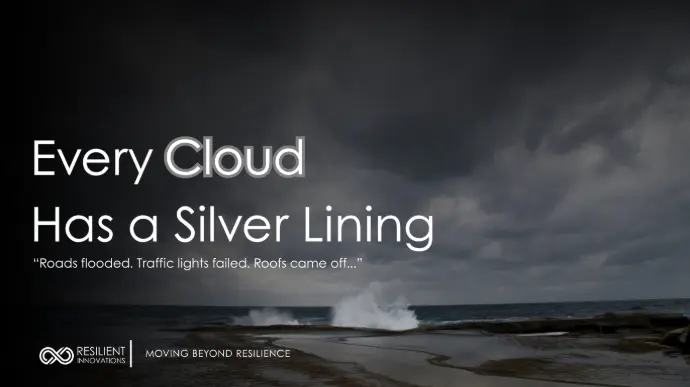
Every Cloud Has A Silver Lining
“Roads flooded. Traffic lights failed. Roofs came off and on top of all those tragic events, a second cold front with winds exceeding 100km/h is already on its way"
As we write this, large parts of the Western Cape are dealing with the aftermath of one of the most severe storms to hit the region.
A Level 8 weather warning is in effect across Cape Town and surrounding regions. Over 6000 people have been affected. Schools across the Western Cape have been closed and 5 people have lost their lives. The City of Cape Town's disaster risk management centre received over 930 emergency calls between 6am and 9:30am alone. Across the Overberg, entire towns from Pringle Bay to Hermanus lost power after 66kV breakers tripped at Hawston, knocking out electricity across the entire region. Roads flooded. Traffic lights failed. Roofs came off and on top of all these tragic events, a second cold front with winds exceeding 100km/h is already on its way and as unfortunate that is, somewhere in all of that, businesses opened their doors to a day they had not planned for.
South Africa has always dealt with extreme weather, but the scale of this week's disruption and how quickly it escalated from a single infrastructure failure into a regional operational crisis is a reminder that disruption does not discriminate but arrives without warning and separates the prepared businesses from the unprepared.
Continuity capability does not solely depend on a single continuity plan document with no prior testing. A document describes what an organisation intends to do, and a capability is what an organisation does when faced with a crisis. What makes weather events particularly dangerous from a business resilience perspective is not the initial disruption itself. It is the cascade. Take as a clear example, the single power line failure in Hawston this week did not just affect one town. It tripped 66kV breakers that removed electricity from an entire region. Traffic lights went dark. Fuel stations could not operate pumps. Businesses that had generators found their suppliers did not. Staff who could work remotely found their home connectivity gone. The cascade moved faster than any response plan that had never been rehearsed.
This is the reality of modern operational risk. Systems are so deeply interconnected that a single point of failure rarely stays single for long. A vendor goes down and takes your operations with it. Every organisation that experienced disruption this week was, in some way, dealing with a failure that originated outside its own walls.
This is precisely why Business Continuity Management must extend beyond a business' own systems and into the full dependency map, every vendor, every utility, every third party and every piece of infrastructure that the business relies on to function. An honest BCM framework does not just ask what happens if our systems go down but prepares and tests for what will happen when everything goes down at the same time.
To maintain operations in an environment as volatile as the Western Cape, businesses must anchor their resilience in a strategic framework of recovery services:
- Work Area Recovery (WAR)
- Backup as a Service (BaaS)
- Disaster Recovery as a Service (DRaaS)
Together, these three pillars form a comprehensive shield. Backup as a Service protects your information, while Disaster Recovery as a Service restores your digital heartbeat, and Work Area Recovery provides the life support for your human capital.
To the businesses and communities affected by this week's storm, we hope your recovery is swift, your people are safe and the second front brings less disruption than the first and To every business watching from the outside, this week is a reminder to rethink business continuity because real Resilience is built before the storm and not during it.
As we write this, large parts of the Western Cape are dealing with the aftermath of one of the most severe storms to hit the region.
A Level 8 weather warning is in effect across Cape Town and surrounding regions. Over 6000 people have been affected. Schools across the Western Cape have been closed and 5 people have lost their lives. The City of Cape Town's disaster risk management centre received over 930 emergency calls between 6am and 9:30am alone.
Across the Overberg, entire towns from Pringle Bay to Hermanus lost power after 66kV breakers tripped at Hawston, knocking out electricity across the entire region. Roads flooded. Traffic lights failed. Roofs came off and on top of all these tragic events, a second cold front with winds exceeding 100km/h is already on its way and as unfortunate that is, somewhere in all of that, businesses opened their doors to a day they had not planned for.
South Africa has always dealt with extreme weather, but the scale of this week's disruption and how quickly it escalated from a single infrastructure failure into a regional operational crisis is a reminder that disruption does not discriminate but arrives without warning and separates the prepared businesses from the unprepared.
Continuity capability does not solely depend on a single continuity plan document with no prior testing. A document describes what an organisation intends to do, and a capability is what an organisation does when faced with a crisis. What makes weather events particularly dangerous from a business resilience perspective is not the initial disruption itself. It is the cascade. Take as a clear example, the single power line failure in Hawston this week did not just affect one town. It tripped 66kV breakers that removed electricity from an entire region. Traffic lights went dark. Fuel stations could not operate pumps. Businesses that had generators found their suppliers did not. Staff who could work remotely found their home connectivity gone. The cascade moved faster than any response plan that had never been rehearsed.
This is the reality of modern operational risk. Systems are so deeply interconnected that a single point of failure rarely stays single for long. A vendor goes down and takes your operations with it. Every organisation that experienced disruption this week was, in some way, dealing with a failure that originated outside its own walls.
This is precisely why Business Continuity Management must extend beyond a business' own systems and into the full dependency map, every vendor, every utility, every third party and every piece of infrastructure that the business relies on to function. An honest BCM framework does not just ask what happens if our systems go down but prepares and tests for what will happen when everything goes down at the same time.
To maintain operations in an environment as volatile as the Western Cape, businesses must anchor their resilience in a strategic framework of recovery services:
- Work Area Recovery (WAR)
- Backup as a Service (BaaS)
- Disaster Recovery as a Service (DRaaS)
Together, these three pillars form a comprehensive shield. Backup as a Service protects your information, while Disaster Recovery as a Service restores your digital heartbeat, and Work Area Recovery provides the life support for your human capital.
To the businesses and communities affected by this week's storm, we hope your recovery is swift, your people are safe and the second front brings less disruption than the first and To every business watching from the outside, this week is a reminder to rethink business continuity because real Resilience is built before the storm and not during it.